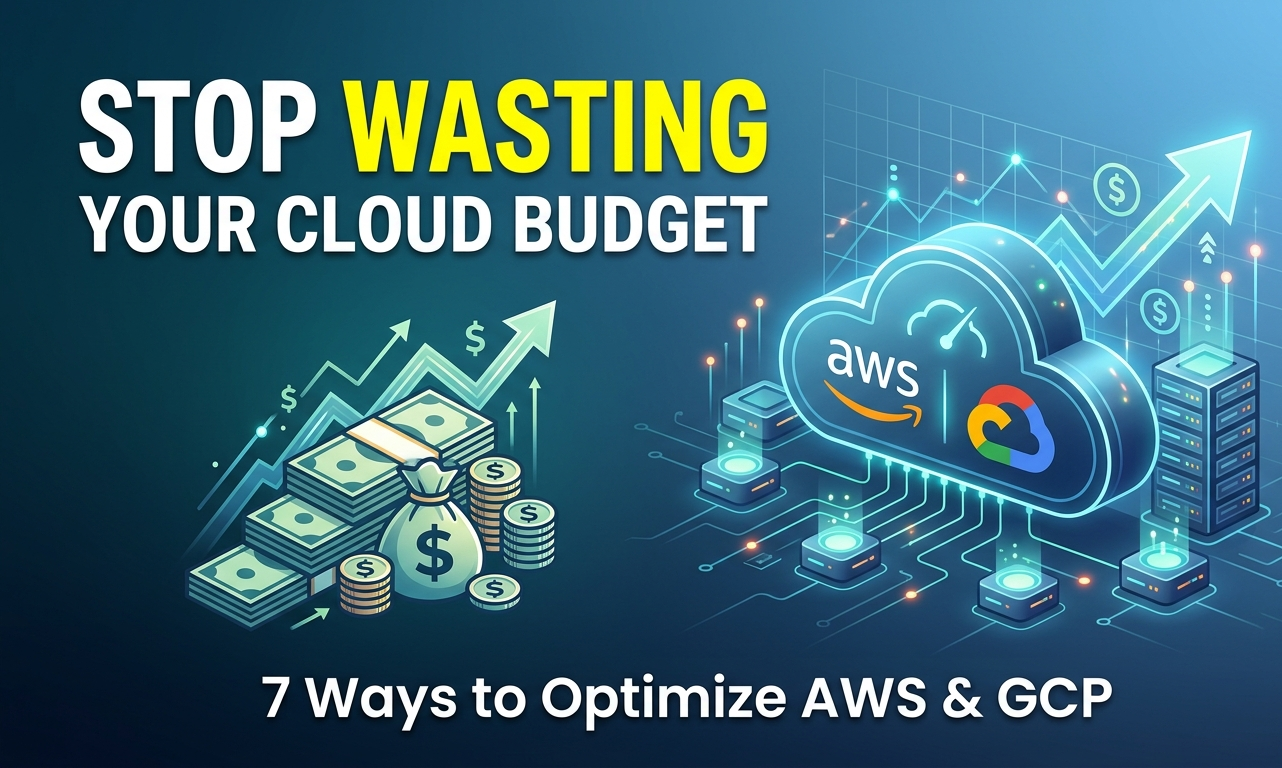
Cloud computing provides the agility needed to build, deploy, and scale modern digital products. Yet, as infrastructure grows, so does the complexity of your monthly bill. Many organizations find themselves overpaying for capacity they do not use, trapped in inefficient purchasing models, or blind to the source of their rising costs.
At The Acinge, we treat engineering as a product. Optimization is not a one-time project; it is a continuous discipline. If you are struggling to keep cloud spend aligned with your growth, here are seven proven ways to optimize your AWS and GCP infrastructure for scale in 2026.
1. Establish Full Cost Visibility with Rigorous Tagging
You cannot manage what you cannot measure. Many organizations struggle with “cloud sprawl” because they lack a unified view of who owns which resource and why it exists.
- Enforce Tagging Policies: Implement a canonical tagging strategy across all environments. Every resource—instances, storage buckets, load balancers—must have tags for
Owner,Project,Environment, andCostCenter. - Automate Compliance: Do not rely on manual tagging. Use cloud-native policy tools (such as AWS Config or GCP Organization Policy Service) to prevent the deployment of untagged resources.
- Implement Showback/Chargeback: Once resources are tagged, use dashboards to allocate costs directly to the product teams or business units responsible. When teams see the cost of their architecture, they become active participants in optimization.
2. Move From Over-Provisioning to Continuous Rightsizing
“Fear-based provisioning” is a common trap. When developers are worried about performance, they often deploy larger instances than necessary. This leads to massive waste.
- Analyze Historical Data: Use AWS Compute Optimizer or GCP Recommender to analyze your actual CPU and memory utilization over the last 30 to 60 days.
- Rightsize Vertically and Horizontally: Transition from oversized single instances to a larger number of smaller, appropriately sized instances. This improves both cost efficiency and fault tolerance.
- Automate Recommendations: Treat rightsizing as a recurring engineering task. Integrate automated reports into your sprint planning to ensure infrastructure keeps pace with actual application demand.
3. Align Purchasing Models with Workload Patterns
Paying on-demand rates for 24/7 steady-state workloads is the fastest way to blow your budget. Modern cloud providers offer multiple pricing tiers designed to reward long-term stability.
- Reserved Instances and Savings Plans: For your stable, baseline workloads, commit to 1 or 3-year terms. These commitments can provide discounts of 30 to 72 percent compared to on-demand rates.
- Spot and Preemptible Instances: For batch processing, CI/CD pipelines, or stateless microservices, utilize spot or preemptible instances. These utilize spare cloud capacity and can reduce costs by up to 90 percent.
- Strategic Mix: A healthy cloud budget uses a mix: on-demand for spikes, spot for fault-tolerant tasks, and reservations for your core foundation.
4. Implement Demand-Based Auto-Scaling
Static infrastructure is a relic of the past. If your resources are not scaling in response to traffic, you are paying for capacity during off-peak hours that could be utilized elsewhere or spun down entirely.
- Scale in Both Directions: Ensure your auto-scaling policies are as aggressive at scaling down as they are at scaling up.
- Schedule Non-Production Environments: Dev, QA, and staging environments do not need to run 24/7. Automate the shutdown of these environments during nights, weekends, and holidays to realize immediate, no-impact savings.
- Queue-Based Scaling: For worker fleets, use queue depth as a trigger for scaling. This ensures you only add compute when there is actual work to process.
5. Optimize Data Storage and Lifecycle Management
Storage costs often grow silently. A few forgotten snapshots or unused backups seem negligible, but they accumulate into significant monthly expenses.
- Adopt Storage Tiering: Move data that is infrequently accessed from standard storage tiers to lower-cost tiers like S3 Intelligent-Tiering or GCP Archive Storage.
- Lifecycle Policies: Define and enforce lifecycle rules that automatically delete or archive orphaned snapshots, old backups, and logs after a specified retention period.
- Monitor Egress Costs: Data transfer fees, especially cross-region or cross-cloud, can be surprisingly high. Keep compute and storage in the same region whenever possible to minimize network costs.
6. Modernize Legacy “Lift-and-Shift” Architectures
Many teams migrated to the cloud by simply “lifting and shifting” legacy applications. These architectures rarely take advantage of cloud-native efficiencies.
- Transition to Managed Services: If you are running your own database clusters on virtual machines, consider moving to managed services like Amazon RDS or Google Cloud SQL. These services handle patching, backups, and scaling, reducing both operational overhead and total cost of ownership.
- Refactor for Serverless and Containers: Where appropriate, move stateless components to serverless functions or containerized services. This allows you to pay only for the compute cycles consumed during execution.
7. Build a FinOps Culture
Optimization is not just a set of technical configurations. It is a cultural practice.
- Integrate Cost into Engineering Workflows: Hold monthly reviews where engineering leads, not just finance, discuss cost-per-feature or cost-per-user metrics.
- Automate Governance: Set up automated alerts for budget anomalies. If a new deployment suddenly causes an unexpected spike in spending, the responsible team should be notified immediately—not thirty days later when the invoice arrives.
- Make Optimization a Goal: Include infrastructure efficiency as a key performance indicator (KPI) for your engineering teams. When efficiency is recognized as a sign of high-quality code, it becomes a part of the development lifecycle.
Engineering Systems That Teams Can Trust
Modern organizations need more than fast delivery. They need systems that are reliable, secure, and cost-efficient. At The Acinge, we combine deep engineering expertise with product thinking to help you build cloud platforms that scale without breaking the bank.
Ready to get control of your cloud spend?
Plan My Project with The Acinge
Let our experts audit your infrastructure and provide a clear, actionable plan to optimize your AWS or GCP environment.
Want AI to make you money BEFORE coffee?

If you’re reading this thinking, “Cool… but how do I actually turn AI into income?”
That’s exactly what this book is built for:
AI Before Coffee: Your First AI-Powered Income Stream While You Sleep By Afreen Rahat (The Acinge Digital Network)
- Kindle Unlimited: $0 (Read for free!)
- Buy Kindle: $2.99
- Paperback: $7.99
Get it here: https://a.co/d/06UOCkcr
Since releasing this book, the feedback has been overwhelming. Readers aren’t just reading it—they’re texting us saying it’s the first time AI “actually clicked” for them. People are loving this guide because it skips the fluff and goes straight to building systems that pay you while you sleep.
And yes — the methods work even if you prefer Claude, ChatGPT, or both. The real advantage goes to the person who executes.
About the Author: Afreen Rahat is part of The Acinge Digital Network, dedicated to exploring the intersection of AI, business, and digital culture.